
Solar battery safety in Perth: what to do and where it goes
By Clara Tan · Updated 2026-06-22
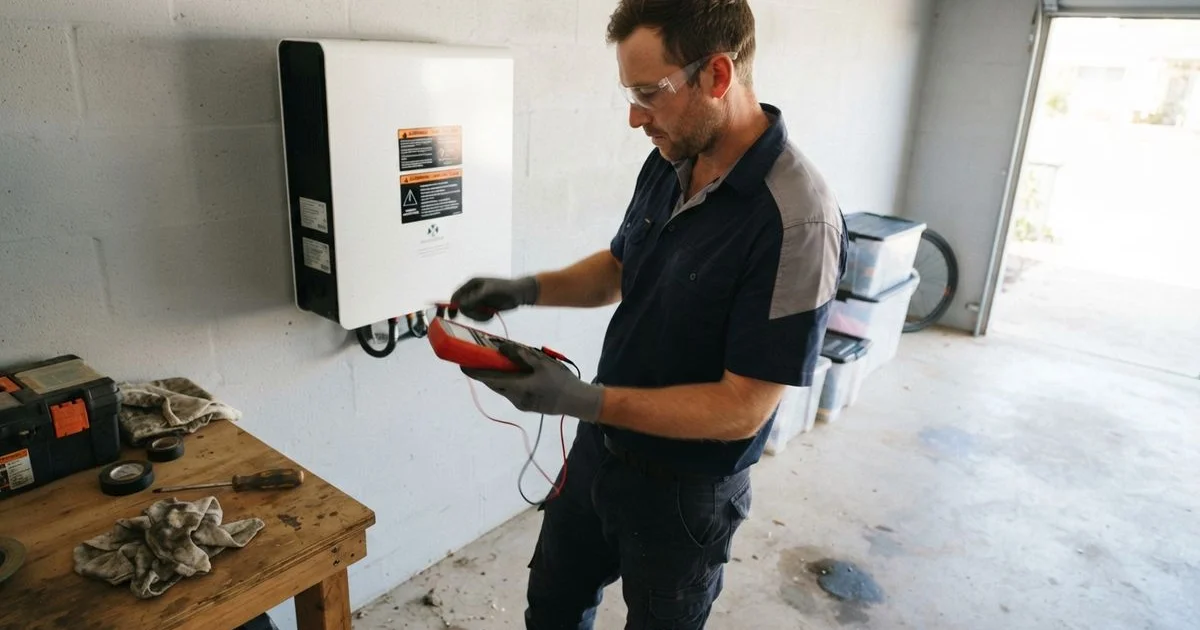
If there is an incident involving a home battery, the Department of Fire and Emergency Services (DFES) says to keep clear, evacuate the building and call 000, telling the operator that a battery energy storage system (BESS) is involved. No one should go back inside while you wait for firefighters.
This is general information, not electrical or safety advice.
What to do if there is an incident
The DFES lithium-ion batteries page gives these steps for a home BESS:
- Keep clear of the BESS and evacuate the building.
- Call Triple Zero (000) and say a BESS is involved.
- Make sure no one goes back inside. Wait in a safe place for firefighters.
- Anyone exposed to spilled electrolyte, flying debris, smoke, vapours or flames needs urgent medical help.
- Treat burns with cool running water for 20 minutes. A burn larger than a 20-cent piece also needs emergency care, so call 000.
Building and Energy adds that a lithium-ion battery fire is self-sustaining and cannot be easily put out with water spray or a fire extinguisher (general page, updated 26 November 2024).
DFES says a BESS damaged by impact, fire or water must not be put back into operation, even if it appears to work, and should be treated as energised. If it is safe to do so, follow the shutdown procedure displayed on or near the switchboard or battery. If you cannot find one, switch the BESS main power switch to OFF. Then contact the manufacturer or an authorised technician. DFES says to fit a smoke or heat alarm in any garage or utility room with a BESS.
The Clean Energy Regulator (CER) says a green reflective “ES” label must be on or next to the meter box and switchboard so emergency services know a battery is on site. Where a multimode inverter has an alternative supply, the main switchboard warning label must include the shutdown procedure (CER inspection results).
What the regulators say about the technology
Building and Energy says in a July 2024 fact sheet that under fault conditions lithium-ion materials can react internally and release flammable and toxic gases, fire and explosive atmospheres, and that the majority of lithium-ion chemistries contain flammable electrolytes. Neither that fact sheet nor Building and Energy’s guide for electrical contractors ranks one chemistry above another, and we do not either.
The CER’s inspection results report, updated 20 October 2026, covers batteries installed since 1 July 2025, with figures to 30 June 2026. Of 3,425 inspections (392 in WA), 0.93% were rated unsafe, 61.78% substandard but safe to remain in operation, and 37.28% adequate and safe. The CER says no installation had an issue with the battery itself: all issues came from installation practices and workmanship. Labelling was the most common substandard item. The sample is installations that claimed small-scale technology certificates, and the CER says it is too early for strong conclusions about compliance rates.
Where a battery can and cannot go
These limits come from the AS/NZS 5139:2019 battery standard, not from manufacturers. We took them from the CER’s inspection checklist (version 1.2, July 2026), which cites clauses 4.2.2.2 and 5.2.2.2. A battery cannot be installed:
- within 600 mm of any exit with an opening of 900 mm or less
- within 600 mm of the vertical side of a window or building ventilation serving a habitable room, or within 900 mm below those items or exits
- in ceiling spaces, wall cavities, under stairways or under access walkways
- on a roof, except where specifically deemed suitable
- in an escape route with less than 1 metre of safe egress
- in the restricted locations AS/NZS 3000 sets for switchboards
The checklist also flags a battery in a habitable room for rectification by the installer.
Building and Energy says licence holders must comply in full with Amendment 1:2025 from 19 June 2026 (page updated 15 May 2026). It says the amendment refines the wording of those two clauses and adds new figures, but gives no distances, so the numbers above are the CER’s, not a WA Government list. Ask your installer which edition they worked to and which clause sets your battery’s position.
Manufacturer rules come on top of the standard: the contractor guide says to install to the manufacturer’s instructions. It also says north and west-facing locations are undesirable in WA because of high solar radiation.
What to ask your installer
- Accreditation and licence. The CER says a battery eligible for the federal discount must be installed by a Solar Accreditation Australia (SAA) installer with a battery endorsement, and to ask to see their accreditation and licence. Use SAA’s accreditation status check. In WA, a licensed electrical contractor must install a BESS that forms part of an electrical installation.
- The exact model. The CER says it must be on the Clean Energy Council (CEC) approved battery list and comply with AS/NZS 5139:2019. energy.gov.au adds that retailers, designers and installers under the Cheaper Home Batteries Program must confirm in writing that the battery is safe and complies with relevant standards.
- Paperwork. Building and Energy says a BESS installation is notifiable work: notices go to the network operator and you get an electrical safety certificate. The contractor guide adds that a Notice of Completion goes to the network operator.
- Hand-over. The contractor guide says it must include training on operating the BESS and shutting it down in an emergency. The CER checklist checks that you got a full system manual.
- Warranty, recall and insurance. energy.gov.au suggests asking whether the supplier has Australian recall insurance and which warranties are the installer’s and which the manufacturer’s. It says to talk to your insurer early.
- Yearly check. The CER says to have a licensed electrician accredited by SAA check the system every year; the contractor guide says maintenance must be done by a licensed electrical contractor unless the system runs at extra-low voltage.
What two listed businesses publish about their batteries
On 20 October 2026 we read the battery pages of 2 businesses in this directory that publish battery packages: Positive Energy Solutions and Plico Energy. We recorded only what each page says. Being listed here is not an endorsement.
Positive Energy’s pages say:
| Brand | Sizes (kWh) | Chemistry stated | Certification stated |
|---|---|---|---|
| SigEnergy SigenStor | 9, 18, 27, 36, 45 | LFP | None on its page |
| Fronius Reserva | 9.5, 12.6, 25, 38, 63 | LFP | IEC 62619:2022 |
| Sungrow SBH | 15, 20, 30, 40 | LFP | IEC 62619 |
| iStore | 10, 20, 30 | LFP | IEC 62619, IEC 62040, UN38.3, RCM |
| BYD HVM | 11, 22, 33, 44 | LFP | VDE 2510-50, IEC 62619 |
| Tesla Powerwall 3 | 13.5, 27, 40.5 | LFP | None stated |
The sizes come from its package page, which says “Prices checked 1 October 2026”. Plico’s package page has no date line. It names AlphaESS and Sigenergy batteries of 9, 9.3, 18.1, 18.6, 27.1 and 27.9 kWh, with no model, chemistry or certification. Its AlphaESS and Sigenergy pages say several models are on the CEC approved product list, without naming which is in each package.
A chemistry name or IEC certificate on a sales page is the seller’s statement, so ask for the CEC listing of your exact model.
How we checked this page
On 20 October 2026 we opened every government and industry-body page linked above and took the distances, dates and figures from it. The DFES page, the energy.gov.au pages and the contractor guide have no date line. The same day we read the websites of Positive Energy Solutions and Plico Energy. We have not inspected or tested any battery, installer or installation. Our scoring method is published.
Frequently asked questions
What should I do if my home battery is damaged or on fire?
DFES says to keep clear, evacuate the building, call 000 and say a BESS is involved, and make sure no one goes back inside.
Where is a home battery not allowed to go?
Under AS/NZS 5139:2019, as listed in the CER’s July 2026 checklist, it cannot go within 600 mm of an exit with an opening of 900 mm or less, or in ceiling spaces, wall cavities, under stairways, on roofs unless deemed suitable, or in escape routes with less than 1 metre of safe egress.
Is a lithium iron phosphate battery safer than other lithium-ion batteries?
No government page we read says so: none ranks one lithium-ion chemistry above another. Building and Energy says the majority of lithium-ion chemistries contain flammable electrolytes, and that fault conditions can release flammable and toxic gases.
What paperwork should I get after the install?
Building and Energy says you should receive an electrical safety certificate, and the contractor sends a Notice of Completion to the network operator.
Questions people ask
- Are home solar batteries dangerous?
- Modern home batteries are designed and certified for residential use, and serious incidents are uncommon. Risk mostly comes from poor installation, damaged cells, or ignoring manufacturer placement rules, not the technology itself.
- Is lithium iron phosphate safer than other lithium battery chemistries?
- It's generally regarded as more thermally stable than some other lithium chemistries, which is part of why it has become common in home solar batteries, though no battery chemistry removes risk entirely.
- Where should a home battery be installed?
- Manufacturers set rules on placement, including clearance from doors, windows and escape paths, and whether indoor or garage installation is permitted. Your installer should be able to show you the manufacturer's specific requirements for your model.
- What should I do if my battery shows a fault warning?
- Follow the manufacturer's guidance in the manual or app first, and contact your installer promptly rather than continuing to use the system as normal. Don't attempt to open or service the unit yourself.